Guides
Consuegra Windmills, Spain: Cycling Cerro Calderico
Cycle to the Consuegra windmills in Spain: 12 whitewashed giants on Cerro Calderico, medieval castle views, and the 365 km Don Quixote journey.
Cadencia team · · 5 min read
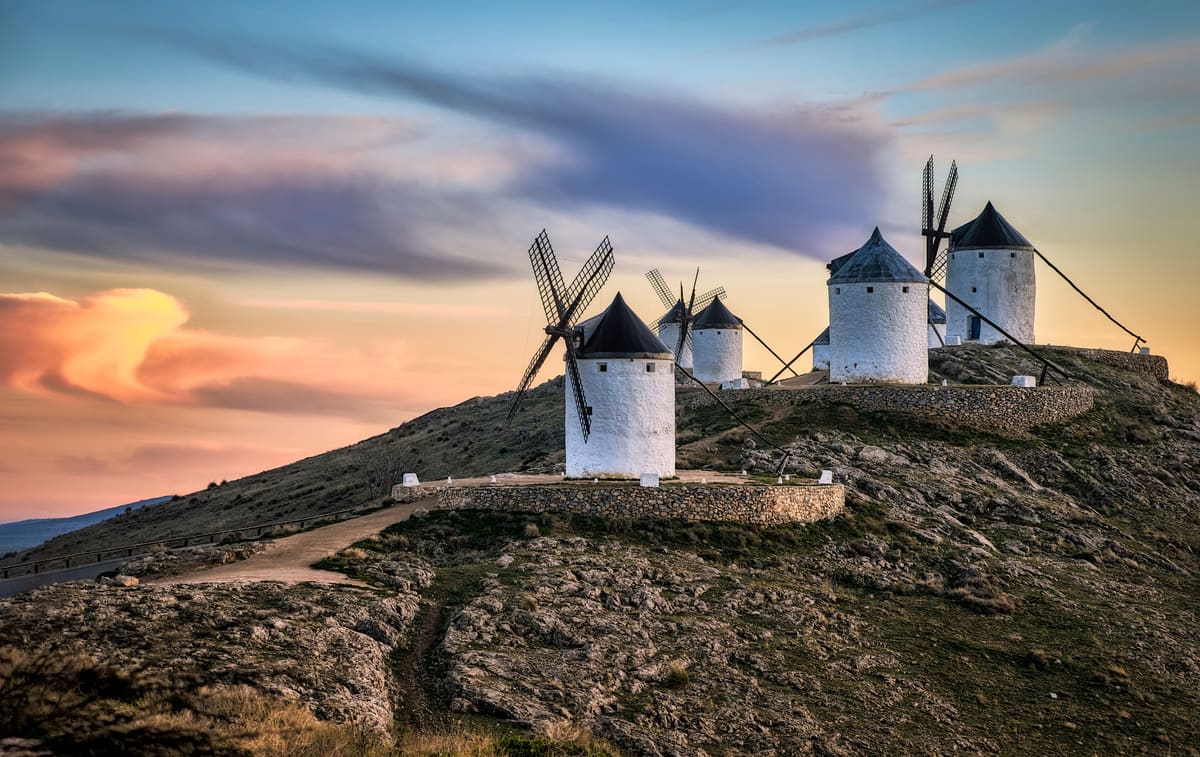
Consuegra windmills in Spain form the most iconic skyline in Castilla-La Mancha, with twelve gleaming whitewashed towers marching along the narrow limestone ridge of Cerro Calderico beside a twelfth-century fortress. Reaching this ridge by bicycle lets you watch the giants grow steadily on the horizon over quiet plains before tackling the short, rewarding climb to the crest.
Twelve whitewashed giants along Cerro Calderico
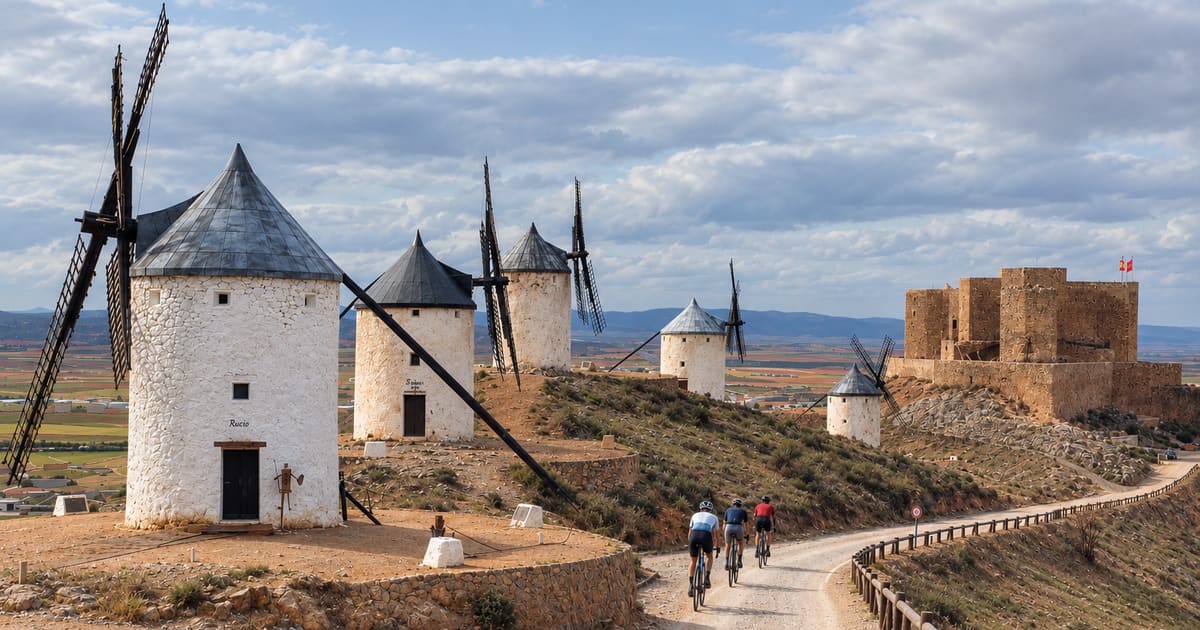
Rising sharply above the town of Consuegra in southern Toledo province, Cerro Calderico acts like a natural stone ship anchored in a sea of vineyards, olive groves, and cereal fields. Standing at roughly 760 metres above sea level, the ridge catches prevailing winds from every quarter, explaining why sixteenth-century millers chose this exact spine to grind grain. Each surviving windmill carries a literary name inspired by Cervantes' novel, from Bolero and Rucio to Sancho and Clavileño. Seen from the saddle as you approach across the plain, the white cylinders and dark conical roofs read like an unmistakable landmark long before you hear the breeze humming through the wooden lattices.
Unlike crowded coastal monuments, Cerro Calderico preserves space and stillness. Morning and late-afternoon cyclists often share the paved crest road with little more than swallows and the sweeping panorama across La Mancha.
How the windmills worked and why they still stand
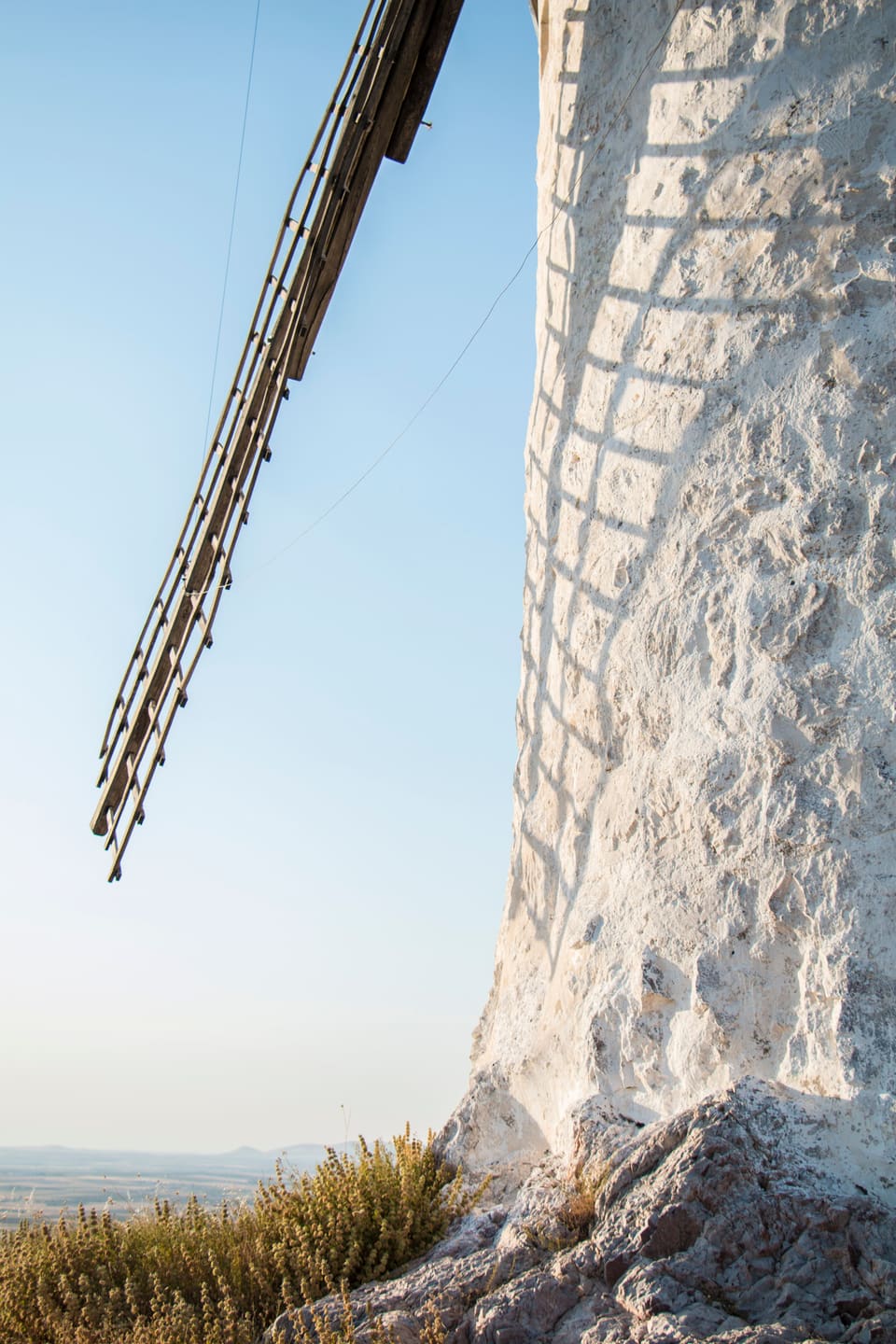
Windmills arrived in La Mancha during the sixteenth century as water-scarce plains demanded an alternative to river mills. Millers built thick circular stone towers topped with rotating timber roofs that could be turned into the wind using a long rear pole anchored to stone bollards around the base. Inside, wooden gears translated the rotation of four canvas-rigged sails into the steady grind of massive circular millstones. Several towers on Cerro Calderico still display intact interior machinery and host live demonstrations during autumn heritage festivals.
| Ridge landmark | Historical role | What cyclists notice today |
|---|---|---|
| Molino Bolero | Municipal visitor windmill | Houses historic milling gear and visitor information near the main ridge access |
| Molino Rucio | Preserved working-style tower | Intact internal gears illustrating how grain dropped through three timber floors |
| Molino Sancho | Sixteenth-century survivor | Retains original machinery activated during Consuegra's October saffron festival |
| Castillo de la Muela | Fortress of the Order of Saint John | Restored medieval walls, keep, and sweeping battlements midway along the ridge |
| Southern crest road | Ridge-top viewing lane | Quiet paved ribbon linking every tower with uninterrupted 360-degree views |
Combining the castle walk with a look inside one of the restored mills takes less than an hour, leaving plenty of time to sit in the sun and trace the afternoon road ahead across the plain.
Riding up to Consuegra on the Don Quixote journey
Approaching Consuegra on two wheels restores the true scale of Cervantes' landscape. On our scheduled Don Quixote journey, riders cross from Toledo into the heart of La Mancha along quiet tracks and empty secondary roads before ascending the short, punchy ramp onto Cerro Calderico. The final climb lasts only a couple of kilometres, yet its switchbacks deliver immediate drama as each turn opens wider vistas across the plateau below. Road cyclists spin smoothly up the tarmac spur, gravel riders link straight in from white agricultural tracks, and e-bike riders glide to the top with plenty of energy left for photos.
Every detail along the stage reflects thoughtful support: cold water and regional snacks wait in the van, and nobody rushes you off the viewpoint. For a broader overview of the literary stops along the full crossing, read our guide to the Don Quixote route in Spain.
Golden hour, saffron harvests, and quiet La Mancha tracks
Light transforms Consuegra more dramatically than almost anywhere else on the central plateau. At midday the limestone and lime-washed plaster glare brilliantly white, while late afternoon turns the towers warm apricot and stretches long shadows of the sails across the ochre soil. October brings an added sensory layer when Consuegra celebrates its Rosa del Azafrán festival. Purple crocus blossoms carpet neighbouring fields at dawn, and families harvest delicate red saffron stigmas before the sun climbs high, scenting local kitchens for months to come.
- Best photography angle: pause along the ridge path just south of Castillo de la Muela looking north so the castle walls frame the marching line of windmills.
- Wind awareness: La Mancha breezes can pick up in the afternoon, so carrying a light gilet keeps the descent comfortable even on sunny spring days.
- Pair with wine: local cellars around the plateau offer structured Cencibel reds and crisp whites explored in our Castilla-La Mancha wine guide.
From Toledo to Almagro: the full six-stage arc
Consuegra serves as a thrilling early highlight within a much richer six-stage narrative. Starting beneath the towers of historic Toledo, our scheduled In the Footsteps of Don Quixote itinerary spans 365 kilometres and 2,120 metres of gentle elevation gain all the way to the theatrical main square of Almagro. After descending from Cerro Calderico, cyclists pedal east towards Argamasilla de Alba and the Cueva de Medrano, traditionally linked to Cervantes' imprisonment, before reaching the crystalline pools and waterfalls of Lagunas de Ruidera. The closing stage finishes in Almagro's green-shuttered Plaza Mayor, home to the intact seventeenth-century Corral de Comedias. Compare this classic crossing with our eight other regional routes on the journeys overview, or message our team directly through the contact page to check scheduled departure dates or arrange a private group crossing.
Frequently asked questions
How many windmills are standing in Consuegra today?
Twelve windmills survive along the crest of Cerro Calderico, out of thirteen originally built on the ridge centuries ago. Several retain complete wooden milling machinery inside and stand beside the restored medieval Castillo de la Muela.
Is the climb up to Consuegra's windmills difficult by bicycle?
The road up Cerro Calderico is short and very manageable, rising gently from town over roughly two kilometres with a few steeper bends near the top. Riders on road bikes, gravel bikes, and e-bikes all reach the ridge comfortably without needing mountain-climbing fitness.
When is the best time of day and year to visit Consuegra by bike?
Spring (April to June) and autumn (September to November) provide crisp skies, pleasant cycling temperatures, and quiet trails across La Mancha. Arriving in early morning or late afternoon delivers golden light across the white towers and avoids midday glare.
How far are the Consuegra windmills from Toledo and Madrid?
Consuegra lies roughly 65 kilometres south of Toledo and around 130 kilometres from Madrid, making the ridge easy to reach as part of a multi-day supported cycling tour starting in Toledo. Cadencia Travel Experience includes Consuegra as a signature highlight on the six-stage 365 km Don Quixote journey.